An office used to be treated largely as an operational necessity. Find a suitable floor, arrange the interiors, move the team in and get to work. That straightforward equation is becoming harder to apply as businesses think more carefully about how their workplace affects employees, visitors and everyday operations.
For real estate developers in Noida, this has created a more demanding brief. A commercial building is no longer judged only by its façade or the amount of floor area it provides. The experience of reaching it, entering it, moving through it and using it throughout the day has become part of the proposition.
This is particularly relevant for businesses considering office space on Noida Expressway.
The Expressway corridor has developed into an important commercial belt, but its significance goes beyond the road itself. It connects business locations with residential neighbourhoods, institutional destinations and other parts of the NCR. For an organisation with a sizeable workforce, such geography can influence everyday commuting patterns as well as client and visitor access.
Yet location alone cannot carry an office.
Once people arrive, the building has to work. Parking needs to accommodate different patterns of use. Entrances should make sense. Elevators have to handle daily movement. Service areas need to remain functional without interfering with the principal circulation of employees and visitors.
This is where the difference between a building and a workplace becomes clearer.
Group 108’s ONE FNG in Sector 142 provides an example of this approach. The project combines office and retail components and includes 21 high-speed elevators, multilevel parking, separate entrances for office and retail users, EV charging pods and a dedicated business centre. These are practical components, but together they influence how the premises function during a normal working day.
There is also the question of what surrounds the workplace.
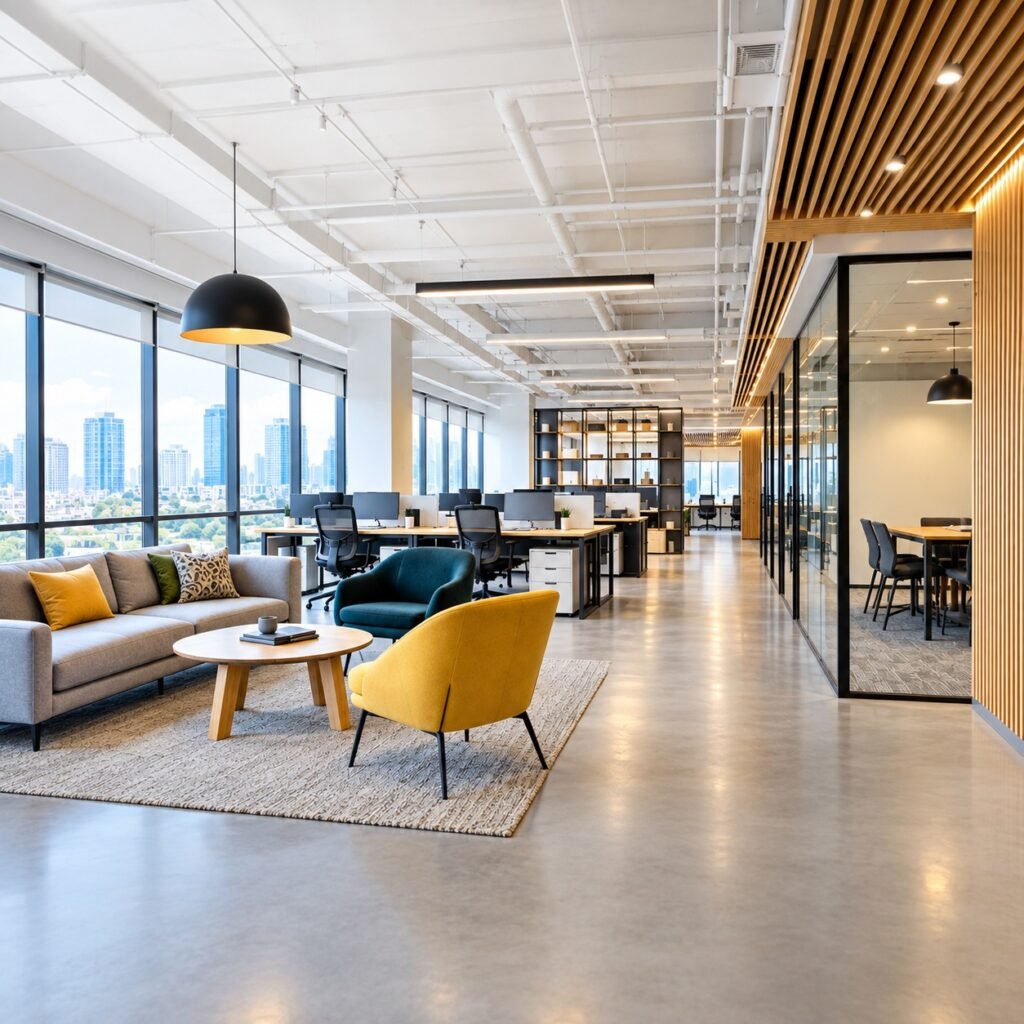
An office does not operate in a vacuum. Employees step out for meals, visitors may need places to wait or meet, and businesses often benefit from having supporting services nearby. ONE FNG incorporates hi-street retail alongside its office component, creating a broader commercial setting rather than treating the workplace as a standalone block.
This kind of planning reflects a larger shift among real estate developers in Noida. The focus is increasingly moving from constructing individual commercial buildings to understanding the patterns of use that develop around them.
Sustainability has entered that conversation too. ONE FNG is described by the project as IGBC Platinum Pre-Certified for Design, with provisions related to green spaces, indoor environmental quality, sustainable materials and energy-conscious planning. For organisations assessing premises over a longer period, such considerations can form part of the workplace decision rather than being viewed simply as architectural credentials.
The same applies to flexibility. Different companies have different ways of organising teams, meeting clients and using common facilities. A useful office environment therefore needs to accommodate more than one fixed working pattern.
For businesses exploring office space on Noida Expressway, the exercise is consequently becoming less about finding an empty floor and more about understanding the setting in which that floor will operate.
The office may contain the desks, meeting rooms and technology. But the real workplace extends beyond them, to the journey employees make, the infrastructure they encounter, the services around them and the ease with which the building handles an ordinary Tuesday.
That is increasingly where commercial planning earns its value: not in how impressive a building looks at first glance, but in how naturally it works once people begin using it.