A retail address can look impressive on paper and still feel forgettable once the doors open. What makes people return is often less obvious: how easily they can move around, what else they can do after shopping, whether there is somewhere to eat, whether the setting feels inviting and, perhaps most importantly, whether the visit feels like more than a transaction.
This is where the idea of commercial space in Greater Noida West is taking on a broader meaning. Newer developments are increasingly being planned around the behaviour of visitors rather than simply the number of shops they can accommodate. Grandthum offers an interesting example of this approach, with its retail component extending beyond conventional storefronts into food, entertainment and leisure.
Its hi-street retail area spans more than 8 lakh sq. ft. and includes over 100 outlets, alongside anchor stores and a hypermarket. But the more interesting aspect is what sits around those retail offerings. The development also incorporates a five-screen multiplex, QSRs, food court spaces and fine-dining options, creating multiple reasons for people to spend time within the project rather than simply arrive, shop and leave.
That distinction matters when assessing retail space in Greater Noida West.
Retail succeeds through movement. A shopper who comes for one purpose may discover another store. Someone arriving for a meal may browse nearby outlets. A family visiting for entertainment may combine the trip with shopping. These overlapping patterns create a more layered form of footfall, where different activities can feed into one another.
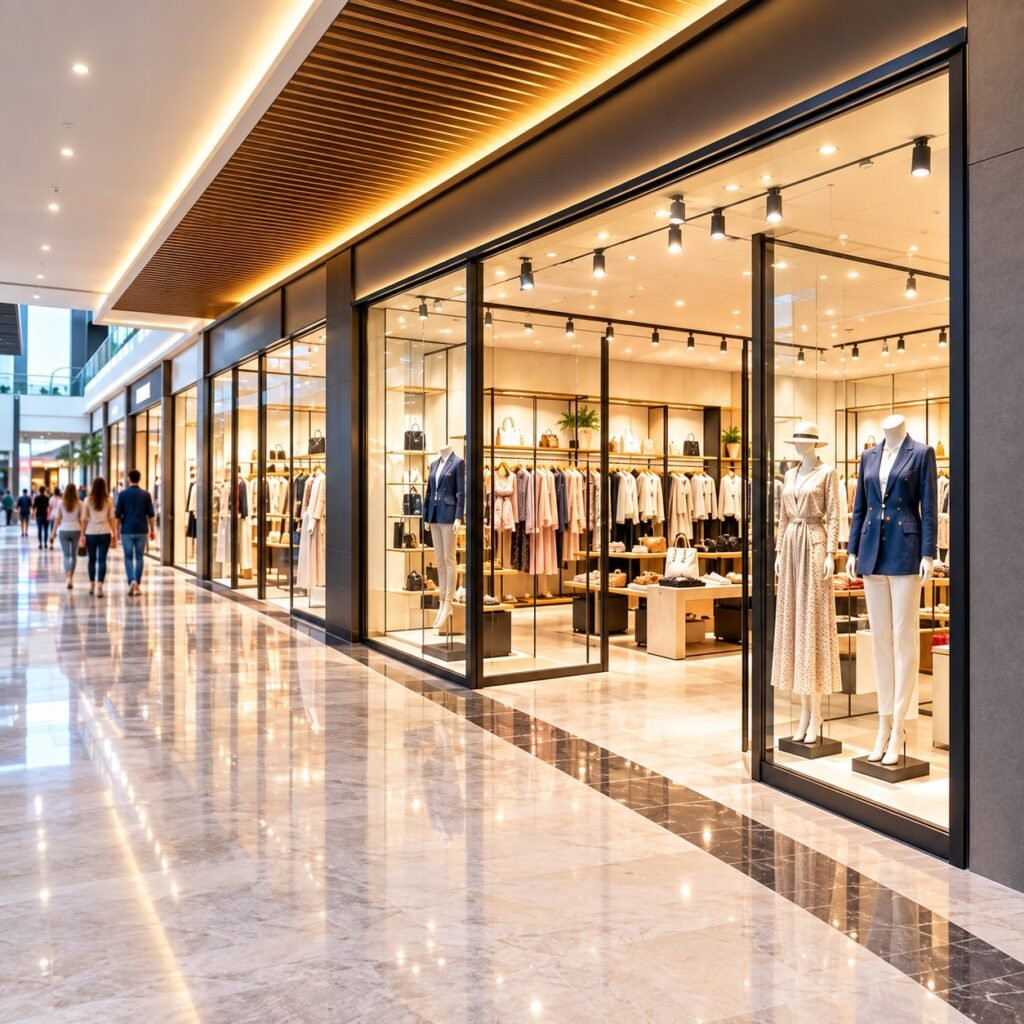
Grandthum’s planning appears to recognise this relationship. Wide boulevards, landscaped promenades, sit-outs and high-speed escalators form part of the project’s circulation strategy. The development also includes a waterscape and a yacht-inspired outdoor area, giving visitors spaces to pause rather than making every part of the experience about moving from one commercial unit to another.
There is a psychological element to this as well. People tend to remember places where they did something rather than merely bought something. A meal with friends, a film, an evening walk, a coffee between errands or simply sitting beside a landscaped water feature can become part of the memory attached to a location.
That is why the physical design of retail environments has become increasingly important. Visibility, circulation, access and frontage remain fundamental, but atmosphere can influence how those fundamentals are experienced.
Grandthum’s approximately 350-metre frontage is another element designed around visibility, while its mix of retail and entertainment gives the project activity beyond conventional shopping hours. The official project information also highlights separate entrances, multilevel parking, 24-hour power backup and three-tier security, bringing operational considerations into the retail equation.
For retailers, therefore, the question is no longer simply whether a shop is positioned inside a large development. The more useful question is what kind of environment surrounds it.
A well-conceived retail setting can give individual stores the benefit of a larger collective experience. Customers may arrive for one attraction and discover another; businesses can become part of a broader pattern of activity; and the development itself becomes easier to remember.
In that sense, Grandthum’s retail proposition is less about putting shops under one roof and more about creating multiple reasons to cross the same streets, explore different corners and return at different times. That distinction could prove increasingly relevant as commercial space in Greater Noida West becomes more experience-led and visitors become more selective about where they spend their time.