A company’s workplace does not begin at the reception desk. For many employees, it begins much earlier—on the road, at the metro station, in the parking area or during the daily calculation of how long it will take to reach work. As business districts spread, commuting has quietly become one of the factors shaping where companies choose to operate.
This makes the rise of commercial projects on Noida expressway worth looking at from a different angle. The Expressway is not simply a road connecting two parts of the region. It has gradually become associated with employment clusters, residential development and commercial activity, creating a corridor where the relationship between movement and work is increasingly visible.
For businesses, location decisions are rarely based on one map pin. They involve employees travelling from different parts of the NCR, clients arriving for meetings, vendors making deliveries and teams moving between offices. A well-connected corridor can therefore influence the everyday functioning of a workplace in ways that may not be obvious from an office floor plan.
Group 108’s presence in this corridor provides one example. ONE FNG, located in Sector 142, combines office and retail components within a development positioned near the Noida-Greater Noida Expressway and FNG corridor. The project also identifies Sector 142 Metro Station as being approximately 0.5 km away. These features place mobility at an important point in the project’s commercial proposition.
But connectivity is not simply about distance.
A location can be geographically close to a major road and still feel inconvenient if movement within the development is poorly planned. Parking, entrances, elevators, pedestrian circulation and service access all influence what happens after someone reaches the site.
This is why the internal organisation of a commercial development matters alongside its external connectivity.
ONE FNG, for instance, provides separate entrances for office and retail users, multilevel parking and 21 high-speed elevators. The project also includes EV charging pods and a dedicated business centre. These details address different parts of the daily movement cycle, from arrival and parking to vertical circulation and business use.
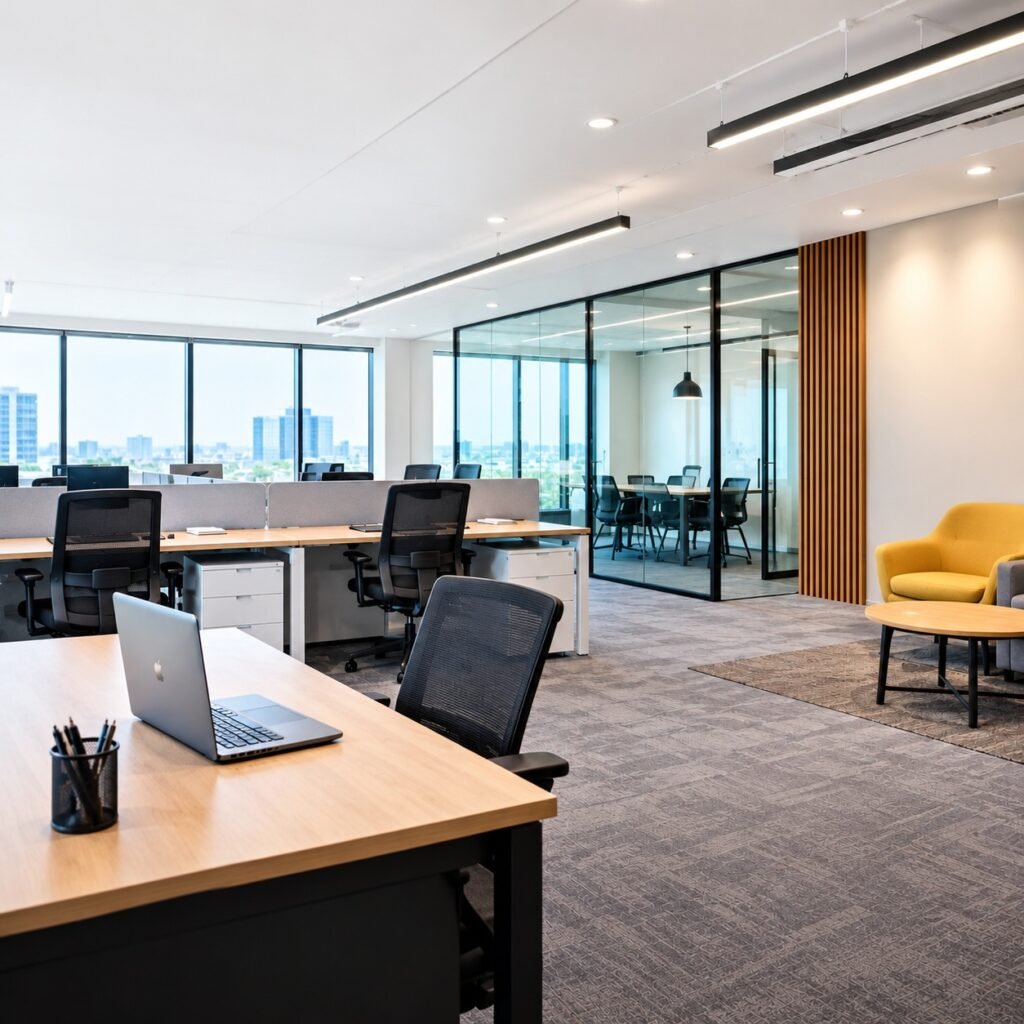
The wider Expressway corridor has another advantage: it connects different forms of development rather than functioning as a purely commercial strip. Residential neighbourhoods, institutional destinations and employment centres exist within the larger geography. That creates the possibility of a workforce living relatively close to where it works, while also bringing supporting services into the same broad urban zone.
For companies considering an office space on Noida Expressway, this broader geography can be more meaningful than simply comparing buildings on paper.
There is also a reputational dimension to location. An address on a recognised business corridor can make it easier for clients and partners to identify where a company operates. But the value of an address ultimately depends on whether the physical experience supports the impression it creates.
That brings the conversation back to the road itself.
As Noida continues to develop, major corridors are becoming more than transportation infrastructure. They are influencing where businesses cluster, where supporting services appear and how people organise their working lives. The office may remain the destination, but the journey to it is increasingly part of the equation.
Group 108’s projects along this broader commercial belt reflect how developers are responding to that reality. The focus is no longer simply on constructing individual buildings; it is also on placing workplaces within locations that connect them to the movement patterns of a growing region.
For businesses assessing commercial projects on Noida Expressway, therefore, the most useful question may not be how close a project is to a particular road. It may be how naturally that location fits into the daily geography of the people expected to use it.